

The right packing system combines strong cartons, controlled cushioning, secure tape, and surface protection. Each material addresses a different transport risk. Cartons carry weight. Bubble wrap absorbs impact. Packing paper prevents rubbing. Stretch film holds protective layers in place.
For moving boxes Dubai retailers commonly stock compact, medium, and tall double-wall cartons. Current UAE listings show three common specifications:
- 41 x 33 x 33 cm with a seller-listed 15 kg capacity
- 45 x 45 x 45 cm with a seller-listed 25 kg capacity
- 45 x 45 x 70 cm with a seller-listed 32 kg capacity
These capacities come from retail product specifications. They do not represent universal engineering limits for every carton.
This guide helps you match packing materials with household items. Use the room-by-room packing plan to decide when each material is needed in the kitchen, bedrooms, living areas, bathrooms and storage spaces. It also provides a box estimate for studios, 1BHK, 2BHK, and 3BHK homes.
Start with the carton, then add cushioning, closure, and furniture protection.
Which packing materials are used for moving?
Moving materials include corrugated cartons, wardrobe cartons, packing paper, bubble wrap, packing tape, stretch film, moving blankets, dividers, mattress covers, and corner guards.
1. Cartons and wardrobe cartons
A corrugated carton uses fluted paper between flat liner sheets. A double-wall carton contains three liner sheets and two corrugated mediums.
Double-wall construction provides more vertical compression strength and cushioning than single-wall board. The Fibre Box Association also links larger flute profiles with greater cushioning and vertical compression strength.
Match carton size with item weight:
- Pack books, canned goods, tools, and compact appliances in small cartons.
- Pack cookware, shoes, toys, and mixed household goods in medium cartons.
- Pack bedding, cushions, lampshades, and light plastic items in large cartons.
- Pack hanging garments inside wardrobe cartons.
Large boxes create a common packing mistake. People fill them with books, plates, or canned food. The box becomes heavy before the available space runs out.
Wardrobe cartons contain a hanging rail. They fit suits, dresses, abayas, uniforms, jackets, curtains, and long garments. Keep shoes and dense accessories out of the base. Extra weight can strain the bottom panel.
2. Bubble wrap and packing paper
Bubble wrap creates an air-filled cushioning layer around breakable or impact-sensitive objects. Small bubbles fit glassware and polished surfaces. Larger bubbles provide deeper cushioning around electronics, artwork, and irregular objects.
Manufacturer specifications list inflatable bubble heights of about 6 mm, 13 mm, 19 mm, and 25 mm. The correct size depends on item weight, fragility, shape, and available carton space.
Packing paper protects polished surfaces, separates stacked items, and fills small gaps. Unprinted paper avoids ink transfer onto crockery, fabric, or light-colored surfaces.
A published packing-paper guide suggests these starting quantities:
- About 200 sheets for a studio or one-bedroom home
- About 500 sheets for a multi-room home
- About 1,000 sheets for a larger household or extensive fragile collection
The actual quantity depends more on possessions than floor area. A small apartment with extensive glassware may use more paper than a lightly furnished 2BHK.
3. Packing tape and stretch film
Packing tape closes carton seams. Carrier guidance specifies strong packaging tape at least 5 cm wide. Common commercial rolls measure 48 mm by 50 meters, which closely matches that specification.
Use pressure-sensitive carton tape rather than masking tape, decorative tape, or office tape. Apply tape across clean and dry cardboard.
A current technical sheet for one industrial carton tape specifies storage between 4°C and 27°C. It also specifies 40% to 50% relative humidity. Product requirements vary, but the data shows why tape belongs indoors rather than inside a hot vehicle.
Stretch film secures moving blankets, drawers, cables, cushions, and removable parts. Stretch film does not replace cushioning. Place a moving blanket against the furniture first, then secure the blanket with film.
Corrugated packaging also has measurable recycling attributes. European industry data reports 88% recycled content in new corrugated packaging. The paper-and-board recycling rate reached 82.5% in 2022. These figures represent European benchmarks rather than Dubai recycling rates.
Which boxes fit kitchen items?

Small and medium double-wall cartons fit most kitchen items. Kitchen contents become heavy before a large carton becomes full.
1. Match the carton with the item
Use the following combinations:
- Small cartons: Spice jars, mugs, canned food, cutlery, coffee equipment and dense pantry items
- Medium cartons: Pots, pans, mixing bowls, containers and countertop appliances
- Large cartons: Trays, kitchen towels, plasticware and light pantry goods
- Dish cartons: Plates, bowls, glassware, bottles and serving dishes
- Cell-divided cartons: Glasses, stemware, jars and small ceramic pieces
Published kitchen-packing guidance also recommends small or medium cartons for appliances, pots, pans, and dense kitchen contents.
Place cookware at the bottom. Add lighter bowls or plastic items above it. Keep each carton manageable for repeated lifting through corridors, lifts, ramps, and loading bays.
2. How do you pack plates and glasses?
Wrap each plate with one or two sheets of packing paper. Place plates vertically, similar to a dishwasher rack. Vertical rows reduce direct pressure across plate faces.
Two separate packing guides recommend placing dishes on their sides or in vertical rows rather than flat stacks.
Cell dividers isolate glasses and stemware. Place one wrapped item inside each compartment. Fill unused cells and upper gaps with crumpled paper.
Pack small appliances inside their original cartons when available. Otherwise, wrap each appliance and use a close-fitting double-wall carton. Fill all open space around the appliance.
Place oils, sauces, detergents, and other liquids upright. Seal each container inside a spill-resistant bag. Carrier packaging guidance also recommends plastic or spill-proof bags around bottles and containers.
Which materials protect fragile items?
Packing paper, bubble wrap, dividers, double-wall cartons, and controlled void filling protect fragile items. Each item requires separation from other objects and every carton wall.
1. How do you layer fragile-item protection?
Use this 6-step sequence:
- Wrap the surface with packing paper.
- Add bubble wrap around impact-sensitive areas.
- Reinforce handles, stems, corners, and narrow edges.
- Center the item inside a double-wall carton.
- Fill every gap with paper or cushioning.
- Seal the top and base with H-taping.
Carrier guidance places wrapped items away from the sides, corners, top, and bottom. Another packaging guide recommends 5 to 6 cm between the contents and carton wall.
The carton passes a simple movement check when the contents remain fixed during gentle handling. Add more void fill when an item slides, knocks, or changes position.
2. When does double-boxing make sense?
Use double-boxing for crystals, sculptures, artwork, premium electronics, glass ornaments, and irreplaceable objects.
Place the protected item inside a smaller carton. Put that carton inside an outer box at least 15 cm longer, wider, and deeper. Add about 8 cm of cushioning around all six sides.
Two major carrier guides specify an 8 cm cushioning benchmark for fragile, double-boxed goods. One guide also specifies an outer carton at least 15 cm larger in each dimension.
H-taping uses three tape lines on each opening. Apply one strip along the center seam. Add one strip across each edge seam. Repeat the pattern underneath.
A fragile sticker communicates handling instructions. The sticker does not replace carton strength, cushioning depth, dividers, or movement control.
Which materials protect furniture?
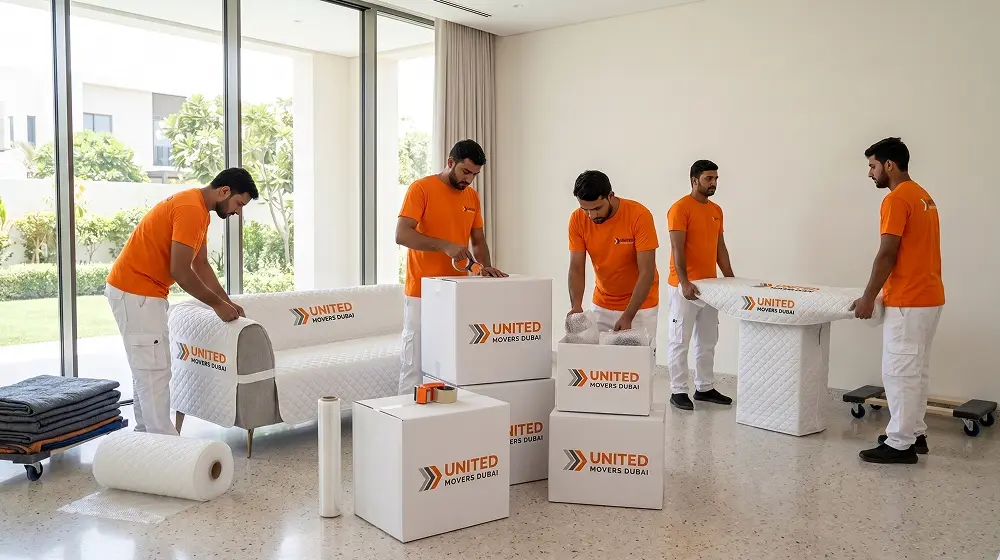
Moving blankets protect furniture surfaces. Stretch film holds those blankets in place. Corner guards, corrugated sheets, mattress bags, and bubble wrap protect vulnerable components.
1. How do you layer furniture protection?
Large wardrobes, beds, sofas, dining tables, mirrors and glass furniture may require furniture movers in Dubai for assessed dismantling, layered protection, controlled lifting and reassembly.
Clean and dry each item before wrapping. Dust trapped beneath plastic or blankets can mark polished finishes during movement.
Use this material order:
- Cover wood, leather, painted furniture, and upholstery with clean moving blankets.
- Add cardboard or foam guards to table corners, headboards, cabinets, and desks.
- Secure the blankets with stretch film.
- Remove shelves, legs, handles, and loose hardware where practical.
- Place hardware inside labeled bags.
- Attach each hardware bag to the related furniture item.
- Use mattress bags around mattresses, bases, and upholstered headboards.
Moving blankets provide the cushioning layer. Stretch film keeps the blanket in position and helps stop drawers or doors from opening.
Do not apply strong adhesive tape directly to wood, veneer, leather, painted surfaces, or coated glass. Apply tape to paper, cardboard, blankets, or stretch film instead.
Use the same room and item codes from your moving box labeling system on cartons, hardware bags, furniture panels and removable shelves.
Protect mirrors and glass tabletops with 5 layers:
- Packing paper against the surface
- Bubble wrap around the complete item
- Corrugated sheets across both faces
- Edge and corner guards
- A moving blanket around the outer layer
Stretch film can then secure the complete protective assembly. Stretch-wrap product guidance also identifies mirrors and pictures as suitable uses when the film secures bubble cushioning.
How many boxes are needed by home size?
A studio commonly requires 20 to 30 cartons. A 1BHK needs about 30 to 45 cartons. A 2BHK needs about 45 to 65 cartons. A 3BHK may require 65 to 95 cartons.
These figures represent planning ranges, not fixed standards. Residents, books, kitchenware, wardrobes, children’s items, balcony storage, and stored possessions change the final count.
The following table provides a starting point for ordering moving boxes Dubai households commonly use.
| Home size | Small cartons | Medium cartons | Large cartons | Wardrobe cartons | Dish cartons | Total estimate |
|---|---|---|---|---|---|---|
| Studio | 6 to 9 | 8 to 12 | 3 to 4 | 1 to 2 | 1 | 20 to 30 |
| 1BHK | 8 to 12 | 14 to 20 | 4 to 6 | 2 to 3 | 1 to 2 | 30 to 45 |
| 2BHK | 12 to 18 | 22 to 30 | 6 to 8 | 3 to 5 | 2 to 4 | 45 to 65 |
| 3BHK | 18 to 25 | 30 to 42 | 8 to 12 | 5 to 8 | 4 to 6 | 65 to 95 |
Complete a moving inventory list before ordering cartons, because furniture, books, kitchenware, wardrobes, balcony contents and stored belongings determine the final quantity.
One room-based model totals 23 boxes for one or two rooms. The same model lists 34 boxes for two or three rooms. Four or five rooms require 62 boxes.
Another current estimate places studios at 20 to 30 boxes. It places three-bedroom homes at 55 to 80 boxes. A separate guide notes that heavily furnished three-bedroom homes can pass 100 boxes.
Use a 10% working buffer when the supplier accepts unused returns. A 40-box estimate becomes 44 boxes. That allowance covers overlooked cupboards, utility areas, and last-day packing.
Buy more small and medium cartons than large cartons. Smaller boxes control dense loads. Large boxes work better for duvets, pillows, lampshades, and lightweight household goods.
Reject used cartons with moisture damage, torn flaps, crushed corners, weak seams, or oil stains. Carrier guidance recommends new or almost-new cartons and the removal of old labels.
After unpacking, flatten clean cartons for reuse or recycling. Dubai Municipality lists several Smart Sustainability Oasis recycling centers. Its recyclable-material collection facility also operates 24 hours a day.
A sound packing plan matches carton size with weight. Bubble wrap addresses impact risk. Packing paper protects surfaces. Tape strengthens seams. Stretch film controls furniture coverings and loose parts.
Pack by weight, surface, and transport risk
A secure move starts before the first carton reaches the truck. Match small boxes with dense items, medium cartons with mixed household goods, and large cartons with lightweight contents. Use double-wall cartons for fragile or heavier loads. Packing paper prevents surface contact, while bubble wrap absorbs impact around glassware, electronics, and decorative objects.
Furniture needs a different system. Moving blankets protect the surface, corner guards cover exposed edges, and stretch film holds each protective layer in place. Tape belongs on cardboard or wrapping material, not directly on wood, leather, glass coatings, or painted finishes.
Order moving boxes Dubai households need it by room, then add a small working buffer for overlooked cupboards and final-day items. A planned material mix keeps cartons lighter, fragile contents stable, and furniture protected during lifting, transport, and unloading.
Customers who prefer the crew to supply, pack and manage all materials can request a survey from our movers in Dubai.
Frequently Asked Questions
Place packing paper or a clean moving blanket against polished furniture before adding bubble wrap or stretch film.
Wardrobe cartons can fail when shoes, books, or other dense items overload the base beneath the hanging rail.
Reuse cartons only when the walls, corners, seams, and flaps remain dry, rigid, clean, and free from crushing.
A 10% buffer covers overlooked cabinets, utility areas, balcony items, and possessions packed during the final hours.
Lina Al-Zarqani is a professional content writer with 12+ years of experience in the movers and logistics field, crafting practical relocation guides, storage advice, and packing strategies tailored to UAE residents. She transforms complex moving processes into clear, actionable information that supports smooth and stress-free relocations. Her writing blends industry knowledge with customer-focused solutions.