

The day that decides an IT move in Dubai is not the day the trucks pull up. It is the Tuesday before. Someone in IT walks over to the rack, opens the back, and realises nobody has labelled the patch cables. The new office floor plan does not match the old power layout. The crew is booked for Friday. By Friday evening, you are not running a relocation. You are running a recovery operation while forty people wonder why their email is dead.
IT equipment is its own thing. Furniture forgives a rough day. Servers, switches, storage arrays, UPS units, none of them really do. One bad knock during transit can take a drive offline. A wrong circuit at the destination can cook a UPS battery on first power-up. A 30-minute delay in re-cabling on a Monday morning means forty staff sitting in front of dark screens while the billing clock keeps running.
This guide covers what an IT relocation in Dubai actually involves. The cost. The runway. The building rules that catch people out. The destination prep that decides whether Monday is fine or terrible.
What IT Equipment Movers in Dubai Actually Handle
The work is wider than just servers. A standard scope on a Dubai IT relocation usually covers:
- Rack-mounted servers and blade chassis
- Workstations, monitors, dock stations, peripherals
- Switches, routers, firewalls, patch panels
- SAN, NAS, and tape libraries
- UPS units and rack PDUs
- VoIP phone systems and meeting-room AV
- Printers, MFPs, document scanners
- Structured cabling and patch leads
- Decommissioned kit going to disposal or storage
Each category has its own rules. Servers want shock-monitored crates and anti-static wrap. Storage arrays need to stay upright and shut down properly before they go in the truck. UPS units are heavier than people expect, often 40 to 80 kg for a 3 kVA unit, and the batteries inside hate sudden movement. Cabling is the cheapest item on any inventory list. It also becomes the most expensive line on the recovery invoice when nothing is labelled and the destination team spends two days reverse-engineering what plugs into what.
A general office relocation Dubai project usually splits into two parallel tracks for exactly this reason. Furniture and files run on one track. IT runs on its own. Same weekend, different teams, different crating standards, different timeline.
What an IT Equipment Move Actually Costs in Dubai
Pricing varies more here than in any other moving category. The equipment count, the fragility class, the re-installation work, all of it pulls the number around. The figures below are for moves inside Dubai. Cross-emirate, add roughly 15 to 25 percent.
| Equipment Profile | Typical Cost (AED) |
|---|---|
| 5 to 10 workstations, 1 small server, basic switch | 2,500 to 5,500 |
| 10 to 25 workstations, 1 to 2 racks, network gear | 6,000 to 14,000 |
| 25 to 50 workstations, 2 to 4 racks, SAN, UPS | 14,000 to 30,000 |
| 50 to 100+ workstations, full server room migration | 30,000 to 75,000 |
| Single rack relocation, no workstation work | 4,000 to 9,000 |
| Data centre suite or colocation transfer | Project-quoted, usually 60,000+ |
Those base numbers cover the physical move and basic protection. They almost never include:
- Pre-move audit and asset tagging, usually AED 1,500 to AED 4,000 on its own
- IT decommissioning at origin (clean shutdown, photos of every rack)
- Re-installation and re-cabling at the destination, often 30 to 50 percent of the move cost
- Network testing and sign-off, around AED 80 to AED 150 per workstation
- After-hours weekend premium, 15 to 25 percent on the move itself
- Specialist crating for fragile or high-value gear
If a quote names one number for a 30-workstation move, three of those line items are missing. Ask for the breakdown before you sign anything. We have seen final invoices come in 60 percent over the original quote on jobs where this conversation never happened.
A Timeline That Actually Keeps Operations Running
Most IT moves in Dubai are scheduled for zero working days lost. Hitting that target needs a runway, not a heroic Sunday from a stressed sysadmin. A mid-size move runs about four weeks of preparation.
Four to three weeks out
- Inventory every piece of kit. Serial numbers, current rack location, owner.
- Run a destination survey. Power capacity, cooling, network drops, rack space.
- Lock the date with the moving company. Notify both buildings in writing.
- Submit move-out and move-in permits to both sides. Lead times are below.
- Order anything new that needs to be on-site at the destination before move day.
Two weeks out
- Photograph every rack, front and back, before anyone touches a cable.
- Label every cable on both ends. Use a numbering scheme that matches the destination plan.
- Brief staff on the cutover plan. Tell them what to do with their workstations on Friday afternoon.
- Check UPS battery health. Weak batteries get replaced before transit, never after.
- Schedule full backup snapshots inside the 48 hours before move day.
Move week
Friday afternoon, staff back up local files, log out, leave the workstations on the desks. Friday evening, IT shuts servers down in the right sequence, the crew packs from the bottom up. Saturday is transit, unloading, rack repopulation, network bring-up. Sunday is testing and the unhappy little surprises that always show up. Monday morning, staff arrive, log in, and ideally nobody phones IT for the first hour.
The week before is where these jobs are won or lost. A crew can pack and drive efficiently. Nobody can fix a missing rack inventory at 11:00 PM Friday with the truck waiting downstairs and the elevator slot ticking down.
Building Rules That Actually Affect Your Office IT Move
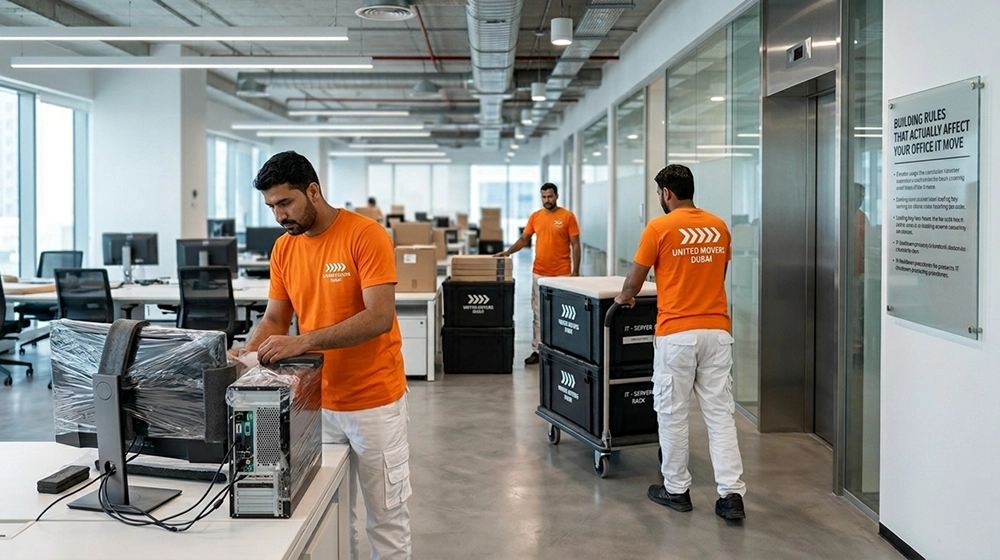
Office buildings in Dubai run the same kind of access regime as residential towers, with a few twists.
For most offices in Business Bay, Sheikh Zayed Road towers, and Dubai Marina, building management wants 48 to 72 hours notice for any move-out or move-in. The standard document set:
- Trade licence of the moving company, issued by DET (the Dubai Department of Economy and Tourism)
- Truck plate number and driver Emirates ID
- Move-out NOC from the outgoing tenant or landlord
- Proof of goods-in-transit insurance
- Service elevator booking confirmation
DIFC is stricter. Most DIFC commercial towers restrict moves to after 6:00 PM on weekdays, or weekends only. The buildings prioritise tenant access during working hours. If your DIFC IT move needs daytime access, you need written exception approval, and that can take a week to land.
Downtown Dubai Emaar buildings want a five-working-day permit lead. The moving crew has to sign a code-of-conduct form before they get access. Deposits at Emaar buildings sit in the AED 1,500 to AED 2,000 range. That covers any damage to elevator panels or lobby flooring during the move.
The constraint people forget is the service lift itself. Most office building service lifts measure 110 to 140 cm wide and 200 to 250 cm deep. A loaded 42U server rack can weigh 400 to 700 kg, and many service lifts cap at 1,000 to 1,500 kg per load. High-density racks may need to be partially stripped, lifted in pieces, and rebuilt at the destination. Plan for that, do not discover it.
Server-Specific Risks During Transit
Servers are not furniture. They tolerate vibration badly, heat badly, and unexpected orientation changes badly. The risks that actually cost money on a Dubai move:
Hard drive shock damage: Spinning HDDs are fragile in transit. A moderate drop produces head crashes or platter damage. SSDs are tougher, not invincible. Anti-static wrap, foam-lined crates, and disciplined loading reduce the risk. Drop indicators on the outside of the crate, the little vials that turn red if shock thresholds are exceeded, are standard kit on high-value servers. If the crate arrives with a red indicator, you have a conversation with insurance before powering anything up.
Thermal stress: Dubai summer turns this into a real variable. Equipment that goes from a 22°C server room into a 45°C truck and then back into a 22°C destination room can develop condensation issues. Moves between June and September really should use climate-controlled trucks for any active component. The MoHRE (Ministry of Human Resources and Emiratisation) midday work ban from 12:30 PM to 3:00 PM, mid-June to mid-September, also limits when crews can load outdoors. That reshapes the day, not the budget.
Static: Dubai air-conditioning combined with synthetic packing materials builds up static charges that surprise people. Anti-static bags for boards. Wrist straps for handlers. Grounded loading equipment, especially for storage arrays and high-end network kit.
Rough power-down: Servers shut down properly survive the journey better than servers that lose power because someone pulled a plug. The IT side of the brief, before move day, includes graceful shutdowns in a documented sequence. Coordinate with the movers so the shutdown happens before crating, not in parallel with it.
What the Destination Side Looks Like
Unloading and reinstallation is where projects lose hours. The pattern is always the same. Loading on Friday is fast. Transit is fine. Saturday afternoon, the project stalls for six hours because the destination network drops are not where the floor plan said they would be.
Pre-move site preparation needs to confirm:
- Network drops are in the right places and the count matches the workstation plan
- Power circuits are commissioned and tested, with the right amperage at server rack positions
- Cooling at the new server room is sized for the inbound equipment, not the previous tenant’s
- Rack space is mapped to the inventory list. Rack PDUs installed and tested.
- Cable trays and ladders run between racks where you need them
- The internet circuit, Etisalat or du, is active and tested before the trucks arrive
Network bring-up runs faster when the destination cabling is already labelled and patched to a documented schema. Crews can move boxes. They cannot reverse-engineer your network design from a tangle of unlabelled blue cables on a Sunday afternoon.
How to Brief an IT Relocation Mover in Dubai
Companies that quote IT relocations in Dubai differ wildly in capability. A standard residential mover quotes on weight and volume and treats your servers as boxes. An IT-aware mover asks different questions and expects you to have answers.
Before you put the job out for quotes, prepare:
- Inventory list with quantities by category (servers, switches, workstations, monitors, UPS, storage)
- Rack count and U-density per rack
- Floor plans for both origin and destination, with rack and workstation positions marked
- Power and network drop counts at the destination
- Move date and acceptable hours of operation at both buildings
- Anything that needs special handling. Tape libraries. Large UPS. Long fibre runs.
- Expected downtime window. Maximum acceptable extension if something goes sideways.
A capable moving company runs a pre-move survey before quoting. They walk both sites. They produce a written method statement covering shutdown sequence, packing standards, transit protection, unloading order, and re-installation responsibility. If a company quotes without surveying both sites, the number is not real.
We work as commercial movers across DIFC, Business Bay, JLT, Sheikh Zayed Road and Internet City. The IT-relocation track runs alongside the furniture and document track on every multi-floor project. Combined-track scheduling is what keeps Monday operations running.
How IT Moves Differ Across Dubai’s Business Districts
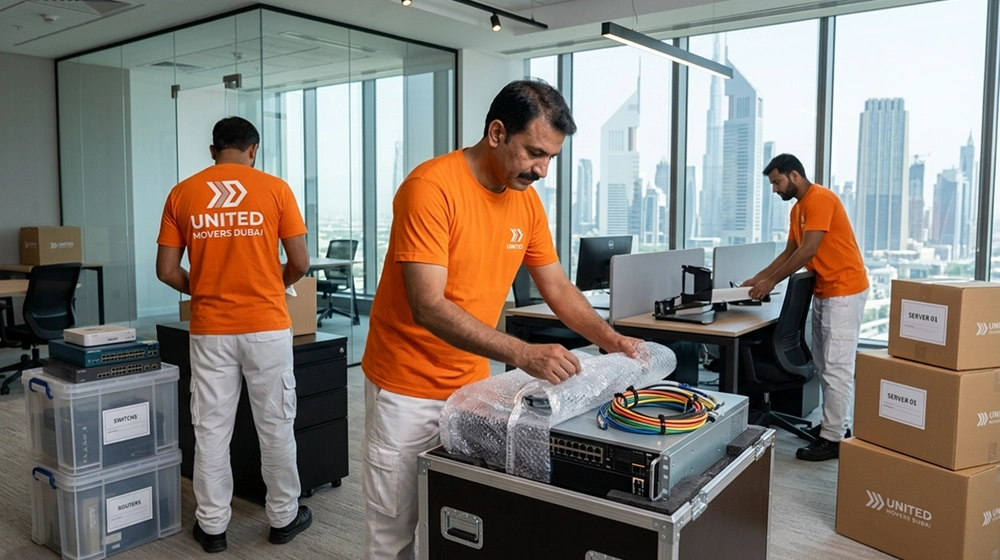
Different commercial districts in Dubai bring different constraints.
DIFC means after-hours access, formal permits, tighter security. Truck access timing is the binding constraint, not the equipment. JLT (Jumeirah Lake Towers) and the Marina towers handle daytime moves more easily, but Sheikh Zayed Road traffic at peak hours pushes transit windows out. Internet City and Media City have purpose-built office stock with reasonable service access. Free zones like JAFZA and Dubai South often need additional approvals from the zone authority on top of the building permit.
For Free Zone offices, allow an extra five to seven working days in the planning runway for zone authority sign-off. The cost is the same. The lead time is just longer.
Storage and Phased IT Moves
Some IT moves cannot happen in one weekend. Phased migrations, where racks one to four go in week one and racks five to eight follow in week three, are common when the destination data hall is being commissioned in stages, or when business continuity rules forbid full cutover at once.
For phased work, our storage solutions include climate-controlled storage of decommissioned equipment between phases, including racks staged for redeployment. Climate-controlled storage runs 30 to 50 percent above standard rates because the temperature and humidity tolerances on IT kit are tighter than on general goods.
Phased moves cost more than single-weekend moves. Usually 30 to 60 percent more, depending on the number of phases. The trade-off is risk. A phase that goes wrong only takes out part of the operation, not all of it.
Useful External References
- Dubai Economy and Tourism for trade-licence verification of any moving contractor
- MoHRE midday break rules for summer work-hour restrictions
Worth checking annually. Both authorities update enforcement details and reporting procedures on their own schedule.
Booking the Move
An IT relocation in Dubai is not a one-truck job. It is a project. It needs a runway, a method statement, an inventory baseline, and a destination side that is ready before the trucks roll. The companies that get this right treat the move as IT operations work that happens to involve trucks. The ones that get it wrong treat it as moving work that happens to involve servers.
Get your free itemised quote at unitedmoversdubai.ae. No obligation, no hidden charges. We will run a pre-move survey of both sites, confirm the building rules with management, and write a method statement that names every step before the first cable is unplugged.
Frequently Asked Questions About IT Equipment Movers in Dubai
A 10 to 25 workstation office with one or two racks of network gear typically runs AED 6,000 to AED 14,000 inside Dubai. Pricing scales with workstation count, rack density, and whether re-installation and re-cabling are included. Specialist work like UPS handling, climate-controlled transit and weekend after-hours premiums adds 15 to 30 percent on top. Always insist on a line-item quote, not a single lump-sum number.
Small offices of 5 to 15 workstations and one server can move over a weekend with operations restored Monday morning. Mid-size moves of 25 to 50 workstations usually run Friday evening through Sunday, with most of Sunday spent on testing and bring-up. Anything above 50 workstations often needs two consecutive weekends or a phased approach across three to four weeks.
Yes, and the difference is meaningful. Servers need anti-static packing, shock-monitored crates for high-value units, climate-controlled trucks during summer, and a graceful shutdown before transit. Spinning hard drives are particularly vulnerable to vibration, so air-ride suspension trucks are preferred for full-rack relocations. Always ask whether the mover uses drop indicators and climate-controlled vehicles before you sign.
Friday evening through Sunday is the standard window because most office buildings allow full weekend access and operations are paused. October to April is preferable to summer months. Thermal stress on equipment during loading and transit is lower in cooler weather. Avoid Eid holidays unless the move is fully pre-cleared. Building management offices may be closed and any permit issue cannot be resolved until the next working day.
The moving company must provide a DET trade licence, vehicle plate registration, driver Emirates ID, and proof of goods-in-transit insurance. Your business needs to provide the move-out NOC from the outgoing landlord or building, move-in approval from the destination building, a signed method statement, and an inventory list for insurance purposes. DIFC and Free Zone moves need extra zone-authority approvals on top.
Yes, and most professional office movers in Dubai run the two tracks in parallel on the same project. Furniture and documents pack and load first. IT runs on its own timeline starting Friday evening once staff have left. Combining both with one provider simplifies coordination, single-point accountability, and unified insurance cover. Confirm before booking that the company has actual IT-relocation experience, not just office furniture work.
Standard goods-in-transit cover protects most equipment up to declared values, typically AED 50,000 to AED 100,000 per item without additional rider. For higher-value gear like SAN arrays or specialised servers, request a declared-value rider before the move, never after. Document any damage with photos before the crew leaves the destination, note it on the delivery sheet in writing, and report formally inside 24 hours. Standard claims usually settle in 15 to 30 working days.
Internal IT teams know the equipment but rarely have the moving infrastructure. Trucks. Lifting gear. Anti-static crates. Climate-controlled transport. Building permit experience. The hybrid approach is the common one in Dubai. Internal IT handles shutdown, labelling and reinstallation. A specialist mover handles physical transit and building access. That keeps costs reasonable while keeping operational knowledge inside the team. Trying to run the full move with internal resources alone usually costs more in lost time than it saves on the moving fee.
Lina Al-Zarqani is a professional content writer with 12+ years of experience in the movers and logistics field, crafting practical relocation guides, storage advice, and packing strategies tailored to UAE residents. She transforms complex moving processes into clear, actionable information that supports smooth and stress-free relocations. Her writing blends industry knowledge with customer-focused solutions.