

Key Takeaways
- Always request a site survey before accepting any quote. Phone estimates miss critical details like elevator access, parking restrictions, and fragile items.
- Pricing depends on five key factors: inventory volume, distance between locations, floor level and lift availability, packing scope, and move timing (peak vs. off-peak).
- Insurance matters. Confirm whether the moving company offers transit insurance and what it covers before signing anything.
- Building rules vary across Dubai communities. Many require NOC letters, elevator booking, and specific move-in/move-out time slots.
- Professional packers reduce damage risk significantly compared to self-packing, especially for glass, electronics, and antique furniture.
- Climate-controlled storage is available for gap periods between lease end and new home availability.
- Dubai’s new housing regulations [1] may affect shared accommodation moves, so verify your tenancy documentation is current.
- Technology-enhanced tracking allows you to monitor your shipment in real time during transit.
- Eco-friendly packing options (reusable crates, recycled materials) are increasingly available from movers in Dubai.
What Types of House Moving Services Are Available in Dubai?

House movers in Dubai offer services ranging from furniture transport and partial packing to full-home packing, dismantling, appliance handling and room-by-room setup. The service landscape covers everything from a single piece of furniture to a full villa relocation with white-glove treatment.
Standard residential moving includes disassembly, loading, transport, unloading, and reassembly of furniture. This suits most apartment and townhouse moves within the city.
Villa moving services cover larger properties with specialized requirements: garden furniture, outdoor play equipment, multiple floors, and sometimes separate maid’s quarters. Villas in communities like Dubai Hills Estate or The Springs often have specific community rules for moving trucks and timing.
Additional service categories include:
- Packing and unpacking: Professional packers use industry-grade materials (corrugated cartons, acid-free tissue for artwork, custom crating for chandeliers). Choose full packing, partial packing, or self-pack with supplied materials.
- Furniture transportation only: For single items or small loads, a dedicated furniture moving service is more cost-effective than booking a full crew.
- Climate-controlled storage: Useful when your move-out date doesn’t align with your move-in date. Short-term and long-term storage options protect belongings from Dubai’s heat and humidity.
- Luxury and antique handling: High-value items (art, pianos, antique furniture, wine collections) require custom crating, vibration-dampening padding, and sometimes temperature-controlled vehicles.
- Inter-emirate relocation: Moving from Dubai to Abu Dhabi, Sharjah, or other emirates involves longer transit, potential toll charges, and different building regulations at the destination.
Why this matters: Choosing the wrong service tier means either overpaying for capacity you don’t need or underestimating the crew and equipment required. A site survey resolves this.
How Much Do House Movers in Dubai Typically Charge?
The house moving cost in Dubai depends on inventory volume, packing scope, property access, truck capacity, distance, timing and specialist items.
There is no single fixed rate for residential moving in Dubai. Any company quoting a firm price without seeing your inventory should raise a red flag.
Cost depends on these key factors:
| Factor | How It Affects Price |
|---|---|
| Inventory volume | More items = larger truck + more crew hours |
| Distance | Moves across Dubai cost less than inter-emirate relocations |
| Floor level and lift access | Walk-up apartments without elevators add manual labor time |
| Packing scope | Full professional packing costs more than self-packing |
| Timing | End-of-month, weekends, and summer months are peak periods |
| Special items | Pianos, safes, and artwork require specialized equipment |
General cost ranges (estimates only, not guaranteed):
- Studio/1-bedroom apartment: AED 1,500 – AED 3,000
- 2-3 bedroom apartment: AED 2,500 – AED 5,000
- 3-4 bedroom villa: AED 4,000 – AED 8,000
- 5+ bedroom villa: AED 7,000 – AED 15,000+
These ranges assume a local Dubai move with standard furniture. Add AED 500–2,000 for full packing services depending on home size.
Comparative cost analysis with DIY moving: Renting a truck and doing it yourself might seem cheaper at AED 500–1,000 for the vehicle alone. But factor in packing materials (AED 300–800), potential damage to furniture or walls (no insurance), physical strain, and a full day of personal time. For anything larger than a studio, professional movers in Dubai typically deliver better value when you account for all hidden costs.
Common mistake: Accepting the lowest quote without confirming what’s included. An incomplete quotation may exclude packing materials, dismantling, stair carrying, waiting time or an additional trip. Review the possible hidden moving charges before paying a deposit.
What Does the Moving Process Look Like Step by Step?
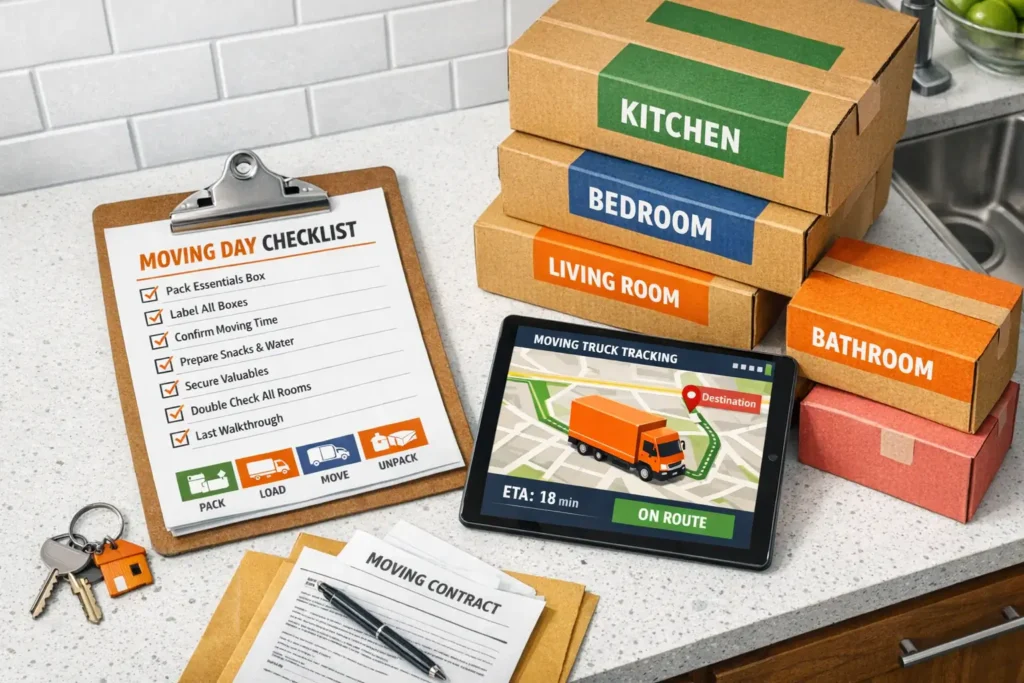
A well-managed house move follows a clear sequence. Understanding each phase helps set realistic expectations and prevents last-minute surprises.
Step 1: Initial Inquiry and Site Survey
Contact the moving company with your current address, destination, approximate inventory, and preferred dates. A reputable company will schedule a physical or video site survey to assess:
- Total volume of belongings
- Access points (elevator size, stairwell width, parking for the truck)
- Items requiring special handling
- Building management requirements at both locations
Step 2: Written Quotation
After the survey, request a detailed written moving quote that confirms the inventory, crew, vehicle, packing, dismantling, access conditions, insurance, VAT and exclusions. This should itemize crew size, truck type, packing materials, insurance coverage, and any additional charges. Compare at least two to three quotes.
Step 3: Move Preparation (1–2 Weeks Before)
- Declutter: Donate or sell items you no longer need. Less volume means lower cost.
- Notify building management at both properties. Book the service elevator and loading bay.
- Gather documentation: Tenancy contract, Emirates ID copies, NOC from current landlord if required.
- Label rooms in the new home so movers know where each box goes.
Step 4: Packing Day (1–2 Days Before Move)
Professional packers arrive with materials. They typically work room by room, labeling every box with contents and destination room. Fragile items get bubble wrap, foam inserts, or custom crating.
Step 5: Moving Day
Follow the moving-day timeline to coordinate crew arrival, access confirmation, loading, transport, unloading, room placement and final inspection.
- Crew arrives at the scheduled time with the truck and equipment.
- Furniture is disassembled, wrapped in protective blankets, and loaded strategically (heavy items first, fragile items secured on top or in padded compartments).
- A loading inventory checklist is completed and signed.
- Transit to the new location. Some companies offer real-time GPS tracking so you can monitor progress.
Step 6: Unloading and Setup
- Boxes and furniture are placed in designated rooms.
- Furniture is reassembled.
- A final walkthrough confirms everything arrived and nothing is damaged.
Step 7: Post-Move Support
Unpacking services are available if booked. Any damage claims should be filed within the timeframe specified in your contract, usually 24–72 hours.
Use the 30-day house moving checklist to coordinate tenancy dates, mover surveys, utilities, permits, packing and moving-day records.
How Should You Prepare for Moving Day in Dubai?
Preparation separates a smooth move from a chaotic one. Dubai’s climate, building regulations, and traffic patterns all require specific planning that differs from moving in other cities.

Moving Day Preparation Checklist
- Confirm the booking 48 hours in advance. Reconfirm truck size, crew arrival time, and contact numbers.
- Check building rules at both locations. Many Dubai towers restrict moves to specific hours (often 9 AM–5 PM on weekdays). Communities like Al Barari or Jumeirah Golf Estates may have additional gate access procedures.
- Secure parking for the moving truck. If street parking is limited, coordinate with building security.
- Protect floors and walls in common areas. Some buildings require protective coverings during moves, and the moving company should handle this.
- Separate essentials. Pack a personal bag with documents, medications, phone chargers, snacks, and a change of clothes. Keep this with you, not on the truck.
- Disconnect appliances at least 24 hours before. Refrigerators need time to defrost. Washing machines should be drained.
- Photograph valuable items before packing. This creates a record in case of damage claims.
- Plan around traffic. Moves starting before 7 AM or after 10 AM avoid the worst congestion on Sheikh Zayed Road and Al Khail Road.
Cultural Considerations for Moving in the UAE
Dubai’s multicultural environment means moving etiquette varies, but a few standard practices apply:
- Ramadan timing: During the holy month, working hours shift and daytime moves may face restrictions. Plan accordingly and confirm crew availability.
- Noise regulations: Avoid early morning or late evening moves in residential communities. Building management enforces quiet hours.
- Gender sensitivity: If household members prefer a female-only packing crew for personal items, some moving companies accommodate this request. Mention it during the site survey.
- Tipping: Not mandatory, but a tip of AED 50–100 per mover is appreciated for good service.
What Insurance and Safety Measures Should You Expect?
Review the mover’s moving insurance and claims policy before booking, including the insured value, covered stages, exclusions, deductible, evidence requirements and reporting deadline.
Every professional moving company in Dubai should offer transit insurance. Without it, you carry all the risk.
Standard transit insurance covers accidental damage during loading, transport, and unloading. Coverage typically ranges from basic (declared value per item) to comprehensive (full replacement value). Ask for the policy document and read the exclusions.
What transit insurance usually covers:
- Accidental drops or impacts during handling
- Damage from vehicle accidents during transport
- Water damage from unexpected leaks in transit
What it usually does NOT cover:
- Items packed by the customer (self-packed boxes)
- Pre-existing damage
- Items of extraordinary value not declared in advance (jewelry, cash, collectibles)
- Damage caused by natural disasters
Safety measures to verify before hiring:
- Crew training: Are movers trained in proper lifting techniques and furniture handling?
- Equipment quality: Does the company use padded blankets, ratchet straps, dollies, and stair-climbing equipment?
- Vehicle condition: Are trucks well-maintained with clean, padded interiors? Climate-controlled options matter for electronics and artwork in Dubai’s heat.
- Licensing: Confirm the company holds a valid Dubai trade license for moving services.
Edge case: For luxury villa relocations involving items valued above AED 50,000 (art, antiques, custom furniture), request a separate high-value item rider on the insurance policy. Standard coverage caps may not be sufficient.
Dubai’s regulatory environment continues to evolve. Recent housing legislation [1][3] introduces stricter rules around property documentation, which can indirectly affect your move if tenancy paperwork isn’t in order. Ensure your Ejari registration and tenancy contract are current before scheduling a relocation.
How Can Technology Improve Your Moving Experience?

Modern movers in Dubai increasingly use technology to reduce errors, improve communication, and provide transparency throughout the process.
GPS tracking lets you follow the moving truck in real time via a mobile app or shared link. This is particularly useful for inter-emirate moves where transit times vary based on traffic conditions.
Digital inventory systems replace paper checklists. Each item is logged with a photo and barcode, making it easy to verify everything arrived at the destination. Disputes over missing items become straightforward to resolve.
Video surveys save time when a physical site visit isn’t possible. You walk through your home on a video call, and the estimator notes volumes, access issues, and special items remotely. While less precise than an in-person survey, video assessments work well for standard apartments.
Online booking and payment portals allow you to confirm dates, review your quote, sign the contract, and make payments digitally. Look for companies that provide a clear digital paper trail.
Eco-Friendly Moving Solutions
Sustainability is gaining traction in Dubai’s moving industry:
- Reusable plastic crates replace single-use cardboard boxes. They’re sturdier, stackable, and returned after the move.
- Recycled packing materials (shredded paper, biodegradable peanuts) reduce waste.
- Route optimization software minimizes fuel consumption by calculating the most efficient path between locations.
- Donation coordination: Some movers partner with charities to collect items you’re decluttering, diverting usable goods from landfill.
Why this matters: For residents in eco-conscious communities, choosing a mover with sustainable practices aligns with broader community values and reduces the environmental footprint of your transition.
How Do You Choose the Right Moving Company in Dubai?
Not all movers in Dubai deliver the same quality. Use these decision criteria to narrow your options.
Choose a full-service mover if:
- Your home has more than two bedrooms
- You own fragile, antique, or high-value items
- You need packing, unpacking, and furniture assembly
- Building access is complicated (no elevator, narrow corridors, high floors)
Choose a basic transport service if:
- You’re moving a small studio or single room
- You’ve already packed everything yourself
- Both locations have easy ground-floor access
Red flags to watch for:
- No physical office or verifiable trade license
- Refusal to provide a written estimate
- Demanding full payment upfront before the move
- No insurance documentation available
- Unusually low quotes that seem too good to be true
Verification steps:
- Check the company’s Dubai trade license number.
- Read recent reviews on Google Maps, not just the company website.
- Ask for references from moves in your specific community.
- Confirm the crew that arrives on moving day is employed by the company, not subcontracted.
For moves across Dubai’s many neighborhoods, local knowledge matters. A company familiar with your community’s building management procedures, gate access, and elevator booking systems will save time and avoid delays.
Use the moving company selection checklist to verify the company’s active licence, legal identity, operational capacity, quotation, insurance and payment details.
Conclusion
Hiring house movers in Dubai comes down to preparation, verification, and clear communication. Start with a site survey to get an accurate estimate. Confirm insurance coverage, building access requirements, and the full scope of services included in your quote. Use the moving day checklist above to stay organized, and don’t hesitate to ask questions about crew training, equipment, and tracking technology.
The difference between a stressful move and a smooth one is almost always in the planning phase, not the moving day itself.
Practical next step: Request a site survey with your current address, destination, and preferred dates. An accurate estimate requires seeing your inventory firsthand.
Frequently Asked Questions
Costs range from approximately AED 1,500 for a studio to AED 15,000+ for a large villa. The final price depends on inventory volume, distance, floor access, packing scope, and timing. Always get a written estimate after a site survey.
Book at least two weeks ahead for standard moves. During peak periods (end of month, summer, school start dates), three to four weeks is safer. Last-minute bookings may incur surcharges or limited crew availability.
Report damage immediately to the crew supervisor and document it with photos. File a formal claim within the timeframe stated in your contract, typically 24–72 hours. Transit insurance covers accidental damage during handling and transport.
Yes. Most professional moving companies offer full packing, partial packing, or materials-only options. Professional packing reduces damage risk and is recommended for fragile, electronic, or high-value items.
Yes, but working hours may be shorter and crew availability more limited. Plan ahead, confirm scheduling, and be mindful of noise restrictions during iftar hours in residential areas.
At minimum: a valid tenancy contract (Ejari registered), Emirates ID, and any NOC required by your building management. Recent housing regulations [1] emphasize proper documentation for tenancy arrangements.
Generally, yes. Weekday moves (Sunday through Thursday) tend to be less expensive than Friday or Saturday moves due to lower demand. Mid-month dates are also typically cheaper than end-of-month.
Many do. Climate-controlled storage facilities are available for short-term or long-term needs, which is useful when there’s a gap between your move-out and move-in dates.
A studio or one-bedroom apartment move usually takes 3–5 hours. A three-bedroom villa may take a full day. Large villas with extensive packing needs can span two days.
October through March offers cooler weather, which is easier on both movers and temperature-sensitive belongings. Summer moves (June–August) are feasible but may require climate-controlled trucks for electronics and artwork.
Related Reading
- Villa Movers in Dubai: Specialized services for villa relocations
- Movers and Packers in Dubai: Full overview of moving services across the city
- Storage Solutions: Climate-controlled options for between-move gaps
Lina Al-Zarqani is a professional content writer with 12+ years of experience in the movers and logistics field, crafting practical relocation guides, storage advice, and packing strategies tailored to UAE residents. She transforms complex moving processes into clear, actionable information that supports smooth and stress-free relocations. Her writing blends industry knowledge with customer-focused solutions.